Custom sheet metal parts in as little as 3 days - Get a quote now!

Why Choose Titanium Welding for Industrial Applications?

Why choose Titanium Welding for industrial applications? The answer begins with performance under demanding conditions. Titanium offers an impressive strength-to-weight ratio, excellent corrosion resistance, and reliable service in challenging environments. It can withstand saltwater exposure, chemical processing, and elevated temperatures without adding unnecessary structural weight.

Titanium Welding requires disciplined preparation. A clean work surface, suitable filler metal, and controlled argon shielding are essential. Even a small amount of oxygen contamination can create discoloration, brittleness, or a weakened weld. Experienced welders often monitor the gas coverage closely, protect the weld pool, and inspect the finished joint for visible and hidden defects. These practices support consistent results in aerospace components, medical equipment, heat exchangers, and industrial piping.

The material is not effortless.

Titanium welding can cost more than conventional steel fabrication. Its sensitivity to contamination also increases training, equipment, and inspection requirements. That limitation deserves honest attention. A poorly planned joint may erase the material’s advantages through rework or premature failure. For this reason, engineers should assess load conditions, service temperature, corrosion exposure, and applicable industry requirements before selecting the process. Qualified fabricators, documented procedures, and appropriate non-destructive testing add practical confidence. When these controls are applied carefully, Titanium Welding can produce lightweight, durable assemblies with long-term value. The best choice is not always the most advanced material. It is the material that matches the real operating conditions.

Why Choose Titanium Welding for Industrial Applications?

What Titanium Welding Involves and How It Works

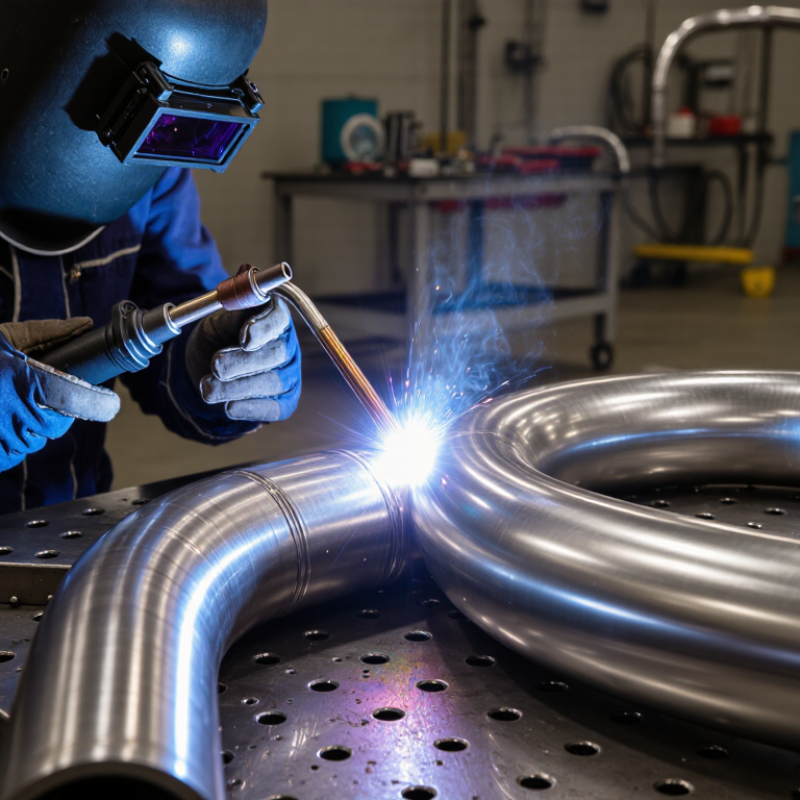
Titanium welding involves controlled heat, absolute cleanliness, and protection from atmospheric gases. Most industrial joints use gas tungsten arc welding, commonly called TIG. The arc melts the joint edges, while high-purity argon shields the molten pool. A trailing shield protects the cooling weld behind the torch. Without that protection, oxygen and nitrogen can embrittle the weld.

Preparation is precise. Operators remove oil, fingerprints, and oxide films with dedicated tools. They also purge the pipe or chamber interior before striking the arc. Heat input must remain low and travel speed steady. A bright silver weld usually indicates sound shielding. Blue, purple, or gray discoloration requires investigation, not acceptance. ISO 15614-5 provides qualification guidance for welding titanium and its alloys. AWS D1.9 also addresses structural titanium welding procedures and inspection practices.

The material’s industrial relevance is substantial. The U.S. Geological Survey’s Mineral Commodity Summaries 2024 reported global titanium sponge production at roughly 210,000 metric tons in 2023. That supply supports aerospace, chemical processing, medical, and marine equipment. Industry reports also identify corrosion resistance as a major driver of titanium demand. Yet welding quality depends more on execution than material reputation. A small shop-floor shortcut can defeat expensive alloy performance. In practice, I would verify shielding-gas coverage with test coupons and inspect each weld visually before advanced testing. Even experienced teams can overlook contamination around a seemingly clean joint.

Key Properties That Make Titanium Suitable for Industry

Why Choose Titanium Welding for Industrial Applications?

Titanium is valued for its high strength-to-weight ratio. A thinner component can reduce equipment weight without sacrificing structural performance. This matters in aerospace fixtures, chemical vessels, and offshore systems where every kilogram affects handling. Titanium also resists seawater, chlorides, and many aggressive chemicals. Its protective oxide layer reforms quickly when the surface remains clean and undamaged.

Temperature performance adds another advantage. Titanium keeps useful strength across demanding service conditions, although engineers must verify the exact alloy and operating range. Its low thermal conductivity concentrates heat near the weld zone. This can limit distortion, but it also makes heat control important. In shop practice, clean gloves, dedicated tools, and complete argon shielding help prevent oxygen and nitrogen contamination. Even a small discolored area may signal weaker weld metal.

The material can support long service life.

Titanium is also useful where low biological reactivity matters, including selected medical and processing equipment. However, it is not a magic metal. Welding requires controlled fit-up, suitable filler selection, and qualified procedures. Visual inspection alone may miss internal defects, so radiographic, ultrasonic, or other testing may be necessary. One practical weakness deserves attention: titanium costs more than common steels, and careless preparation quickly increases waste. A technically strong design may still fail economically if operators ignore cutting losses, joint access, or shielding-gas consumption.

Common Titanium Welding Methods and Their Uses

Titanium welding is valued for its low weight, corrosion resistance, and strength at elevated temperatures. However, these advantages depend on strict control during welding. Even slight oxygen exposure can produce brittle, discolored weld metal. Clean preparation matters.

Gas tungsten arc welding, or GTAW, is the most common method for titanium. It provides a stable arc and precise heat control, making it suitable for thin sheet, tubing, and critical joints. A pure argon shield protects the weld pool, while a trailing shield protects the cooling metal. Internal argon purging is also necessary for pipes and enclosed sections. The weld should appear bright silver or light straw. Heavy blue or gray coloring signals contamination.

Gas metal arc welding can support thicker titanium sections and higher production rates, but it requires careful parameter control. Orbital GTAW is useful for repeatable tube joints in chemical processing, medical equipment, and aerospace systems. Plasma arc welding offers deeper penetration for selected thicker components. Laser welding can create narrow, low-distortion seams, although alignment and cleanliness must be exceptional. Resistance welding is sometimes used for overlapping thin parts.

The method is not universal. That is easy to forget. A skilled fabricator checks joint design, thickness, access, shielding, and inspection requirements before choosing equipment. In practice, rushed cleaning or weak gas coverage causes more failures than the arc itself. Procedure qualification, visual inspection, and suitable non-destructive testing help confirm weld reliability.

Why Choose Titanium Welding for Industrial Applications? — Common Titanium Welding Methods and Their Uses
Welding Method Typical Thickness Range* Primary Shielding or Environment Main Advantages Common Industrial Uses Key Limitations Process Suitability
Gas Tungsten Arc Welding (GTAW / TIG) Approximately 0.5–6 mm for many manual applications; thicker sections may require multiple passes High-purity argon shielding for the arc, weld pool, electrode, and heated trailing area Excellent control, clean welds, low spatter, and strong results on thin titanium components Aircraft components, chemical-processing pipework, heat exchangers, medical parts, and precision fabrications Relatively slow; highly sensitive to surface contamination, drafts, and inadequate post-weld shielding Excellent for thin-to-medium titanium sections and high-quality joints
Laser Beam Welding (LBW) Approximately 0.1–8 mm, depending on laser power, joint design, and material condition Localized inert-gas shielding, usually argon or helium; some systems use controlled chamber protection Low heat input, narrow heat-affected zone, low distortion, high speed, and suitability for automation Automotive and aerospace assemblies, thin tubing, battery-related components, precision instrument parts, and hermetic joints Higher equipment cost; tight fit-up, accurate joint preparation, and process control are required Excellent for automated, repeatable, low-distortion production
Electron Beam Welding (EBW) From thin sheet to thick sections; deep-penetration capability can support multi-millimeter and substantially thicker joints Vacuum chamber, which minimizes atmospheric contamination during welding Very deep penetration, narrow heat-affected zone, low distortion, and high weld purity Aerospace structures, high-integrity pressure components, propulsion hardware, and critical titanium assemblies Requires vacuum equipment; chamber size can limit component dimensions and production flexibility Excellent when weld integrity and deep penetration outweigh equipment complexity
Plasma Arc Welding (PAW) Approximately 1–10 mm, with keyhole operation used for suitable joint geometries Inert plasma and shielding gases, commonly argon-based mixtures More concentrated arc than conventional TIG, good penetration, and potential for mechanized production Tube and pipe fabrication, aerospace parts, chemical equipment, and medium-thickness sheet assemblies More complex setup than TIG; torch alignment, gas coverage, and parameter control are important Very good for mechanized welding of thin and medium sections
Gas Metal Arc Welding (GMAW / MIG) Approximately 3–12 mm in specialized applications, depending on alloy, transfer mode, and shielding design High-purity inert shielding gas, generally argon or helium-rich mixtures Higher deposition rate than TIG and better productivity for longer welds Large structural fabrications, thicker plate, and production work where productivity is important Greater risk of contamination, spatter, porosity, and weld-quality variation; less common than TIG for critical titanium work Good with strict control for production applications requiring higher deposition rates
Resistance Spot Welding (RSW) Typically thin sheets, often below approximately 3 mm total stack thickness Shielding gas is generally not required because the weld is formed between electrodes, although surface cleanliness remains essential Fast cycle times, repeatability, and suitability for overlapping sheet assemblies Thin titanium sheet components, brackets, enclosures, and selected aerospace subassemblies Limited joint geometry; electrode force, current, surface condition, and heat balance must be carefully controlled Good for repetitive lap joints in thin sheet
Friction Stir Welding (FSW) Commonly used for sheet and plate assemblies; practical thickness depends strongly on tool design and machine capacity Solid-state process; no melting, filler metal, or conventional arc shielding is required Low distortion, reduced solidification defects, and no need for filler metal or arc generation Selected plate structures, transportation components, and research or specialized industrial assemblies Requires specialized tooling, rigid fixturing, high machine forces, and suitable joint access Promising to very good for compatible linear joints and solid-state applications
Important process note: Titanium reacts readily with oxygen, nitrogen, and hydrogen at elevated temperatures. Clean joint preparation and complete inert-gas protection are essential. The thickness ranges shown are general engineering guidelines rather than universal limits; the final method should be selected according to titanium grade, joint design, production volume, equipment capability, inspection requirements, and applicable welding specifications.

Quality, Safety, and Environmental Controls in Titanium Welding

Titanium welding earns its place in industrial applications through controlled quality, not appearance alone. On the shop floor, clean preparation is decisive. Oils, fingerprints, and steel particles can weaken the joint before the arc starts. I use dedicated tools, clean gloves, and carefully fitted parts. Argon shielding must cover the weld pool and hot metal behind it. A dull silver surface often indicates protection; blue or gray colors deserve investigation. Small details matter.

Safety begins with the process layout. Good ventilation removes gases and heat, while suitable eye, hand, and respiratory protection reduces exposure risks. Operators should inspect hoses, regulators, torches, and gas cylinders before welding. Stored cylinders need secure positioning and clear access. A qualified welder also watches arc length and travel speed, because excessive heat can distort thin titanium. Inspection may include visual checks, dimensional measurement, and non-destructive testing when the service demands it. Records of parameters and repairs support traceability. They also reveal recurring weaknesses.

Environmental control deserves the same attention as weld quality. Accurate gas flow prevents waste, while stable settings reduce rework, electricity use, and discarded material. Fume extraction should be maintained, not merely switched on during audits. That shortcut fails. In practice, no procedure is flawless; contamination can still appear after a careful setup. When that happens, stopping, documenting, and reviewing the cause is more reliable than hiding a disappointing result. Continuous training, calibrated equipment, and honest inspection help titanium components perform safely over time.

Industrial Applications and Limitations of Titanium Welding

Why Choose Titanium Welding for Industrial Applications?

Titanium welding suits aerospace, chemical processing, desalination, and medical equipment. Its density is about 4.5 g/cm³, compared with roughly 7.85 g/cm³ for carbon steel. This weight advantage matters in aircraft frames and rotating equipment. ASM Handbook data also places titanium’s melting point near 1,668°C, with thermal conductivity around 22 W/m·K. Heat moves slowly. That helps control distortion, but it concentrates heat around the joint.

The limitations are less forgiving. Titanium reacts with oxygen, nitrogen, and hydrogen above approximately 400°C. Contamination can create brittle weld zones, even when the bead looks clean. Qualified fabricators therefore use high-purity argon, extended gas shielding, clean tools, and controlled interpass temperatures. AWS D1.9 and related welding guidance emphasize procedure qualification and inspection for critical titanium structures. Small scratches matter.

Material cost remains another concern. The U.S. Geological Survey’s Mineral Commodity Summaries 2024 reported global titanium mineral concentrate production at roughly 8.5 million metric tons in 2023, yet usable titanium metal requires energy-intensive processing. That supply chain adds expense. In practical work, titanium can reduce lifecycle weight and corrosion repairs, but only when preparation is disciplined. A rushed setup can erase the benefit. This is where many project estimates become optimistic.

Why Choose Titanium Welding for Industrial Applications?

Material properties strongly influence welding behavior. This chart compares commercially pure Grade 2 titanium with representative low-carbon steel using a relative index, where carbon steel equals 100.

Key takeaway: Titanium is attractive for aerospace, chemical-processing, marine, and heat-exchanger components because of its low density and corrosion resistance. However, its low thermal conductivity concentrates heat near the weld zone, while its strong reactivity at elevated temperatures requires high-quality inert-gas shielding and careful joint cleanliness. Representative room-temperature values: Grade 2 titanium—4.51 g/cm³ density, 16.4 W/m·K thermal conductivity, and 8.6 µm/m·K thermal expansion; low-carbon steel—7.85 g/cm³, 51.9 W/m·K, and 11.7 µm/m·K. Actual values vary by specification and temperature.