
Custom sheet metal parts in as little as 3 days - Get a quote now!

Top 10 Kitchen Faucet Manufacturers in China

Kitchen faucets are no longer simple taps. Buyers compare water-saving features, finish durability, cartridge performance, and installation details. Grand View Research estimated the global kitchen faucets market at USD 7.55 billion in 2023, with a projected compound annual growth rate of 6.4% from 2024 to 2030. These figures suggest steady demand, but market estimates vary by research method and product definition. They are useful context, not a guarantee of any supplier’s performance.

China has a broad network of plumbing-fixture manufacturers, from large export-oriented brands to smaller specialist factories. For overseas buyers, a polished product photo is only a starting point. Check material specifications, production capabilities, quality-control procedures, warranty terms, and the supplier’s experience with your target market. Ask how finishes are tested and whether replacement cartridges are available. Small details matter.

This guide introduces 10 Chinese kitchen faucet manufacturers and offers a practical starting point for comparison. It is not a definitive ranking: factory capabilities and product lines can change, and public information may not reveal everyday consistency. That limitation matters. Treat company claims as leads to verify through current product documents, samples, and direct discussions. The best fit depends on your project’s requirements, order volume, and after-sales expectations—not just a low quoted price.
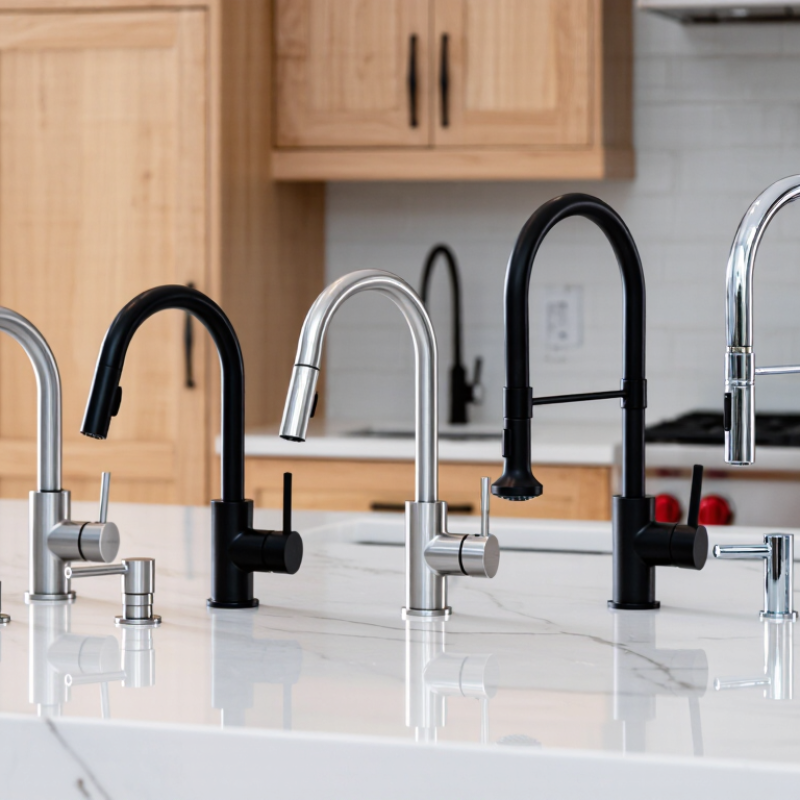
Top 10 Kitchen Faucet Manufacturers in China

Understanding China's Kitchen Faucet Manufacturing Industry

China’s kitchen faucet industry combines metalworking, surface finishing, cartridge assembly, and quality testing. Many manufacturers source brass or stainless steel, then machine faucet bodies to meet specified dimensions. Polishing and plating affect both appearance and resistance to daily wear. Small flaws show quickly.

Supplier capabilities vary. Some factories manage several production stages in-house, while others rely on specialized partners. Buyers should ask how incoming materials are checked, how water-flow and leak tests are recorded, and how production changes are documented. A factory visit or independent audit can help verify these details. Product samples also reveal handle feel, finish consistency, and installation quality. One sample is not enough.

Tips: Request test reports for the exact model, not just a similar product. Confirm material grades, cartridge specifications, packaging, and inspection criteria in writing. Ask for photos or records from a production inspection before shipment. Details matter. If a supplier gives vague answers, pause and check again; specifications can look clear on paper yet leave room for interpretation.

How Kitchen Faucet Manufacturers in China Are Evaluated

Top 10 Kitchen Faucet Manufacturers in China

How Kitchen Faucet Manufacturers in China Are Evaluated

A reliable evaluation starts with the faucet itself, not a polished catalog. Check the body material, finish consistency, handle movement, and cartridge response. Request a sample and inspect it under ordinary kitchen lighting. Look for rough edges, uneven plating, or a handle that feels stiff. Ask how product dimensions and materials are verified across production batches. Details matter.

Testing and quality controls deserve close attention. Ask for documented checks on leakage, water flow, pressure resistance, and cartridge durability. Confirm whether tests apply to every unit or only selected samples. A factory tour is useful, but it can miss problems that appear during a busy production run. Request recent inspection records and clear explanations of corrective actions. Also compare stated production capacity with realistic lead times, packaging standards, and the supplier’s ability to handle design changes. A low quotation means little if replacement parts are difficult to obtain.

Tips: Put key requirements in writing, including finish, dimensions, testing, and delivery dates. Ask the manufacturer to explain any unclear specification in plain language. Compare samples using the same checks, and keep notes. Small inconsistencies can be easy to overlook, even with a careful process.

Top 10 Kitchen Faucet Manufacturers in China

China’s kitchen faucet sector includes manufacturers with different strengths, from precision machining to flexible customization. A useful Top 10 comparison should look beyond polished product photos. Details matter. Check whether a supplier can provide clear material specifications, cartridge information, and documented quality-control procedures.

For a practical evaluation, compare faucet-body materials, finish consistency, handle movement, and connection dimensions. Ask how products are tested for leakage and repeated operation, and request recent inspection records where available. A sample can reveal small issues that a catalog misses, such as a stiff handle or uneven coating. These checks do not guarantee long-term performance, but they make comparisons more grounded.

Manufacturing capacity is only part of the picture. Assess communication, production lead times, packaging standards, and the process for handling defects. Some factories may offer broad customization, while others focus on stable, repeatable models. Rankings are imperfect; supplier performance can vary by product line and order conditions. It is worth verifying claims directly and testing the exact configuration intended for purchase.

Comparing Product Ranges, Standards, and Manufacturing Capabilities

When comparing ten Chinese kitchen faucet manufacturers, look beyond model counts. A useful range includes pull-down and pull-out spouts, bridge designs, multiple spray modes, and replacement cartridges. Ask whether finishes, hoses, and valves are made in-house or purchased. This matters when matching samples to repeat orders. Small detail, big impact.

Standards offer a firmer comparison. Check documented testing against ASME A112.18.1/CSA B125.1 for plumbing supply fittings, and NSF/ANSI/CAN 61 and 372 for drinking-water contact and lead-content requirements. Request current certificates, model coverage, and test reports—not just a logo on a brochure. A certificate may cover only selected configurations. That can be easy to miss.

Manufacturing capability is equally specific: verify casting, CNC machining, polishing, surface treatment, assembly, and pressure or leak testing. The World Bank’s World Development Indicators put China’s manufacturing value added at roughly 26% of GDP in 2023. That scale is useful context, not proof of faucet quality. During supplier reviews, compare defect records, traceability, and production lead times. I would still inspect a production sample; polished showroom pieces can hide uneven spray patterns or stiff handles.

How to Choose a Chinese Kitchen Faucet Manufacturer for Your Needs

Choosing a Chinese kitchen faucet manufacturer starts with your project, not the catalogue. Measure sink-hole spacing, counter thickness, and clearance beneath cabinets. A pull-down faucet may look ideal, yet its hose can catch on plumbing below. Details matter. Send drawings and installation photos with your inquiry. Ask whether the factory makes the faucet body and cartridge in-house or sources key components. Neither setup is automatically better, but the answer should be specific and consistent.

Request a working sample and test the handle, spray modes, and hose retraction several times. Check for drips around the joints, uneven finish, and awkward movement. One sample proves little. Ask how production batches are inspected and request relevant test records, material specifications, and written warranty terms. Confirm minimum order quantities, lead times, packaging, and how defects are handled. A polished showroom sample can hide production variation; consistency matters more than appearance alone. Compare written quotations carefully, since similar prices may cover different cartridges, finishes, or testing. If replies avoid measurable details, pause and ask again. Communication can be imperfect, and that is worth noticing.

Key U.S. Lead-Free Limits for Kitchen Faucets

When evaluating Chinese manufacturers for the U.S. market, check that the finished faucet meets applicable lead-free requirements. U.S. law sets a maximum weighted-average lead content of 0.25% for wetted surfaces and 0.2% for solder and flux. These are regulatory limits, not manufacturer-specific results; request current, product-specific test documentation.