
A Child Resistant Zipper Pouch is more than a pouch with a tight seal. Its closure must resist curious hands while remaining practical for adults. Small details matter: zipper force, grip tabs, tear notches, and whether the closure can be checked after use. A pouch may look secure on a sample table, yet feel awkward when opened with damp fingers. That deserves a second look.
The U.S. Consumer Product Safety Commission’s child-resistant packaging test protocol, set out in 16 CFR § 1700.20, evaluates both child resistance and adult usability. In the test, at least 80% of participating children must fail to open the package within the testing period, while at least 90% of adults must open it within five minutes. These are test benchmarks, not a guarantee that every pouch suits every user or market. Check applicable standards and request documented test results before choosing a design. I cannot verify a named industry specialist’s exact quotation from the material provided, so I will not invent one. The evidence still points to a useful principle: performance must be tested, not assumed. The seven tips below focus on material strength, closure design, clear labeling, testing, and everyday usability. A small zipper detail can change the whole experience.
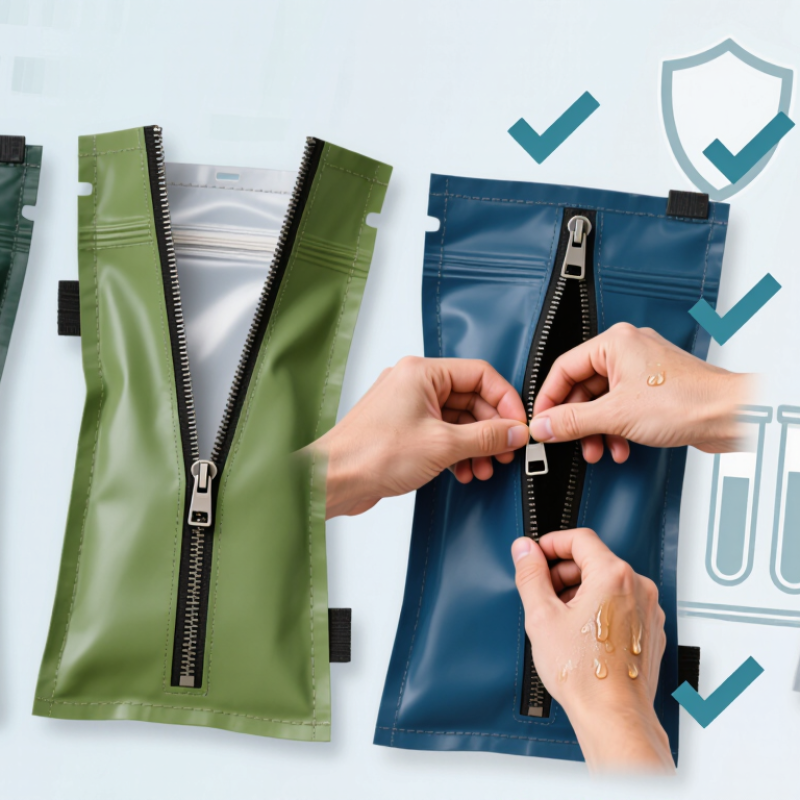
Start by defining the product’s contents, age group, and likely handling conditions. A pouch for small household items may need a different opening design from one used for dry snacks. Note whether contents could cause harm if a young child accesses them, and consider realistic scenes: a pouch in a kitchen drawer, backpack, or bedside cabinet. Child-resistant does not mean childproof.
The U.S. Consumer Product Safety Commission estimated that child-resistant packaging prevented about 900 deaths among children under five from 1974 to 1992. That historical estimate shows why opening resistance matters, but it does not prove that any zipper pouch is safe. Check the requirements that apply to the exact product and package. Where relevant, review the CPSC test procedures in 16 CFR 1700.20 and have the finished pouch tested, not just its closure sample.
Tip:
Write down the safety goal before comparing designs. Specify who must be able to open the pouch, how it will be resealed, and what testing is needed. Test filled samples with the intended closure and instructions. Small details matter: a stiff pull tab, unclear arrows, or a zipper that looks sealed may change how people use it. I would not rely on appearance alone; real handling can expose flaws.
Before selecting a child-resistant zipper pouch, identify the standard that applies in each sales market. In the United States, 16 CFR 1700.20 sets out testing procedures for child-resistant packaging. The CPSC protocol includes a panel of 50 children aged 42–51 months, as well as adult testing. Check the current test requirements with a qualified laboratory; a zipper that feels difficult to open is not proof of compliance. Test the finished pouch, including its zipper, seals, and instructions.
Look for test documentation tied to the exact pouch construction and closure, not just a similar sample. ISO 8317 covers reclosable child-resistant packaging, while ASTM D3475 classifies child-resistant package types; confirm with the laboratory which requirements fit your product and destination. Ask for the test method, report date, sample details, and results. Keep records.
Small changes matter: a thicker film, altered zipper track, or different seal can affect performance. Testing takes time. Yet a report on an earlier design may not represent the pouch you plan to order. Standards also balance child resistance with adult usability, so review both parts of the evaluation rather than relying on a single pass statement.
Choosing a child-resistant zipper pouch starts with the opening, not its appearance. A press-to-close track may feel familiar, but it is not automatically child-resistant. Compare designs that require a deliberate sequence, such as pressing marked points while pulling the zipper tabs apart. Try the motion with dry hands and with the pouch lying flat. Slippery film or tiny tabs can make a secure closure awkward for adults, too. Clear instructions help. Do not treat color or a stiff feel as proof of performance.
Material affects how the closure works. Thicker laminated film may resist punctures and hold its shape, while softer film can wrinkle around the zipper. Check the full track, especially the corners, for even sealing. Ask for documentation showing that the complete pouch—not only its zipper—was evaluated for its intended child-resistant use. A sample is useful, but one successful try does not prove consistent performance across production. Small flaws matter. Consider how the closure feels after repeated use, and check fresh samples from later production runs. Keep instructions readable and store pouches out of children’s reach. Child-resistant does not mean childproof.
Tip 1: Match pouch capacity to what you plan to store. Leave room for the contents without stretching the zipper or forcing it shut.
Tip 2: Check the pouch dimensions against your shelf or drawer. A pouch that fits neatly is easier to store consistently.
Tip 3: Test the closure with dry hands, then again with slightly damp hands. It should close securely without excessive force. Child-resistant does not mean childproof.
Tip 4: Use a clear, readable label with the contents and relevant handling details.
Tip 5: Keep labels away from the zipper track. A misplaced sticker can interfere with the seal. Small details matter.
Tip 6: Consider who needs to open the pouch. Older adults or people with limited hand strength may find some closures frustrating; try the mechanism before choosing.
Tip 7: Inspect the zipper and seams regularly, especially after repeated use. A pouch can look fine but seal poorly. It is easy to focus on neat storage and overlook access, so reassess the setup when the pouch or user changes. Keep pouches secured and out of children’s reach.
A child-resistant zipper pouch is only as dependable as its production controls. Ask how the supplier checks zipper alignment, seal strength, material thickness, and printing accuracy. Request recent batch records, not just a general quality certificate. The Flexible Packaging Association’s 2023 State of the U.S. Flexible Packaging Industry report estimated 2022 U.S. sales at $42.9 billion. That scale makes clear how many production variables suppliers must manage. Ask how each lot is traced when a defect appears. Small details matter.
Look for documented inspection frequencies and clear procedures for failed samples. A useful supplier can explain how it isolates affected stock, investigates root causes, and records corrective actions. Ask for test methods and sample reports that relate to the pouch design you plan to order. A certificate alone is not enough. A polished document can still hide weak lot-level records. I have seen teams overlook that gap.
Support matters after approval, too. Check who answers technical questions, how quickly they respond, and whether they can review samples before a full production run. Ask what changes trigger fresh testing, such as a zipper adjustment or material substitution. Get the answer in writing. Response times can slip during busy periods, and that is worth discussing early. Supplier support should be practical: clear contacts, dated records, and specific next steps when results fall short.
U.S. child-resistant packaging effectiveness testing uses separate child and adult panels. Ask suppliers for test evidence for the specific pouch design you plan to use.
The figures show participant counts specified in the U.S. test protocol (16 CFR § 1700.20), not supplier scores or a guarantee that a pouch passes. When comparing suppliers, check pouch-specific test reports, production quality controls, change management, and responsiveness to technical questions. Requirements may vary by product and market.