
Custom sheet metal parts in as little as 3 days - Get a quote now!

Top Neodymium Magnet Manufacturers for Global Buyers

Choosing a Neodymium Magnet manufacturer is not just a search for the lowest quoted price. Global buyers need to compare product consistency, technical support, production capacity, and communication across time zones. A magnet that looks right in a catalog may behave differently under heat, vibration, or repeated handling. Small details matter.

This guide introduces manufacturers serving international markets and outlines practical points buyers can use to assess them. Look for clear specifications, including dimensions, magnetic grade, coating, and permitted tolerances. Ask how samples are checked and whether test reports correspond to the actual production batch. A tidy datasheet helps, but it does not answer every question. Follow up.

Supplier capabilities can vary by magnet shape, order volume, customization needs, and delivery destination. Some manufacturers may be strong in high-volume production, while others offer more responsive engineering support for specialized designs. Buyers should verify current certifications, lead times, packaging practices, and after-sales procedures directly rather than relying on broad claims. This takes time.

A fair comparison also considers the full purchasing process: sample approval, quality documentation, shipment coordination, and how problems are handled. No supplier fits every project, and a polished website is not proof of dependable performance. Even experienced buyers can overlook a tolerance or coating requirement when specifications are rushed. This guide is a starting point, not a substitute for technical review. By asking specific questions and checking evidence, global buyers can make better-informed decisions and find manufacturers suited to their application, budget, and timeline.
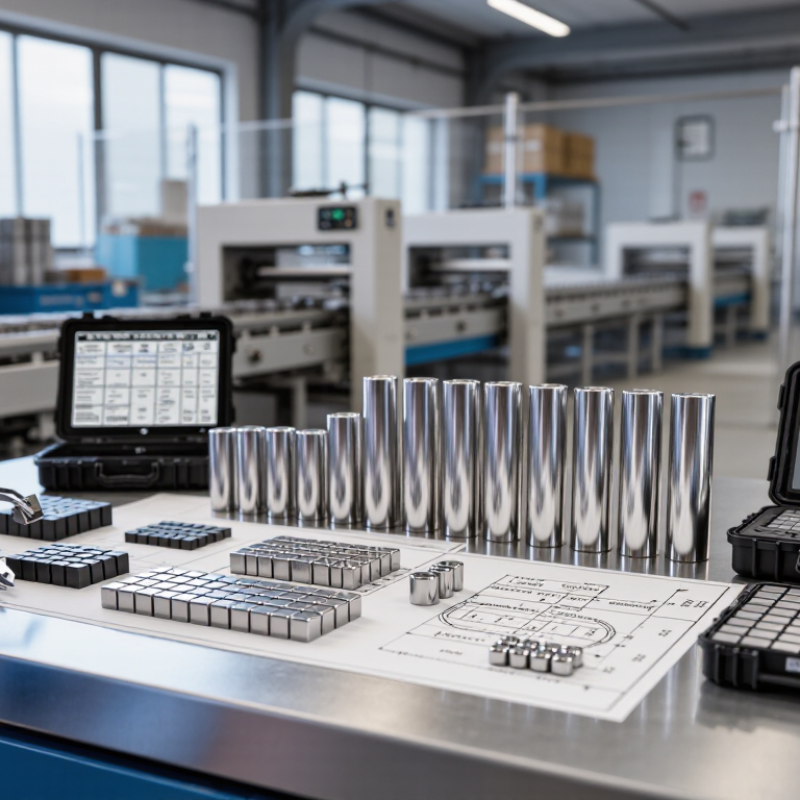
Top Neodymium Magnet Manufacturers for Global Buyers

What Neodymium Magnets Are and How They Are Made

Neodymium magnets are permanent magnets made mainly from neodymium, iron, and boron. This alloy, often called NdFeB, can produce strong magnetic force in a compact shape. A small disc magnet, for example, may hold firmly against a steel cabinet. Strength varies with grade, temperature, and design. The material can corrode, so many magnets receive a protective coating.

Manufacturing begins by melting measured ingredients into an alloy. The alloy is cooled, crushed, and milled into fine powder. Workers press this powder into a shape, often while applying a magnetic field to align its particles. The compact is then sintered in a controlled furnace. Heat bonds the particles into a dense solid. The process sounds tidy on paper; in production, it is less forgiving.

After sintering, manufacturers grind the magnet to its specified dimensions. This step matters because brittle material can chip if handled poorly. A coating, such as nickel or another protective finish, helps reduce corrosion. Magnets are then exposed to a strong field to establish their final magnetization. Quality checks may measure dimensions, magnetic strength, and coating condition. Small details matter. Buyers should also consider operating temperature and the part’s intended use, since a powerful magnet can still perform poorly when mismatched to its application.

How the Global Neodymium Magnet Industry Is Structured

The neodymium magnet industry is a supply chain, not a single factory category. It begins with rare-earth materials, which are processed into metals and blended with iron and boron. Alloy makers then prepare the material for pressing and sintering. Magnet producers shape, heat-treat, machine, and coat the finished pieces. Each stage affects consistency. Small changes in alloy composition or furnace conditions can alter magnetic performance.

Production is concentrated in a limited number of regions, while sales and application engineering reach buyers worldwide. Some suppliers make magnets themselves; others source them and provide machining, coating, or assembly. That distinction is easy to miss. Buyers should ask who controls each production step and where inspection records are kept. A useful evaluation includes dimensions, magnetic grade, operating temperature, coating, and batch traceability. For example, a thin nickel coating may suit a dry indoor assembly, but not every humid or corrosive setting. Samples should be checked against the actual design, not just a catalogue description.

The structure can look more transparent than it is. Subcontracting may shift between orders, and a familiar specification does not guarantee identical performance. Requesting test data and confirming the production location can reveal gaps. Price matters, of course. So does the cost of a rejected batch.

What Distinguishes Leading Neodymium Magnet Manufacturers

Leading neodymium magnet manufacturers distinguish themselves through consistent production, not impressive catalog numbers alone. A clear specification should cover grade, dimensions, tolerances, coating, and operating temperature. Details matter. In practice, a few tenths of a millimeter can affect how a magnet seats inside a motor assembly. Reliable manufacturers check dimensions and magnetic performance across production batches, then keep records that help buyers trace results to a lot. That discipline is more useful than a broad promise of “high quality.”

Engineering support is another difference. Experienced teams ask how the magnet will be mounted, what temperatures it will face, and whether it needs a protective coating. They can explain trade-offs without treating a standard grade as suitable for every job. Ask for inspection data, sample parts, and written confirmation of critical tolerances before approving a large order. Samples can reveal edge chipping or a coating that marks during handling. Not every supplier gets every detail right; even a careful process can miss a problem, so incoming checks still matter. Clear communication about lead times, packaging, and corrective action helps buyers judge whether a manufacturer is dependable beyond the first shipment.

Top Neodymium Magnet Manufacturers for Global Buyers: What Distinguishes Leading Suppliers?

Typical maximum energy product ranges for common NdFeB grades

A supplier’s grade range is one useful comparison point: higher maximum energy product grades can deliver greater magnetic strength for a given magnet volume. These are typical ranges in MGOe; exact specifications can vary by manufacturer and product.

How Global Buyers Can Evaluate and Compare Suppliers

A strong supplier comparison starts with the application, not the lowest unit price. Define the required pull force, working temperature, dimensions, magnetization direction, and acceptable variation before requesting quotations. Grade labels help, but they do not describe the complete operating result. Details matter. Request material specifications, coating details, inspection criteria, and recent lot test data. Check how measurements are taken; a force reading changes with air gap, steel thickness, and test setup.

Compare samples using identical fixtures and conditions. Ask for evidence. A polished sample can hide variation across a production batch, so ask how process consistency is monitored. Also review packaging, stated lead times, minimum order quantities, and how quickly technical questions receive clear answers. That is not enough. For critical applications, discuss sample approval and an agreed inspection plan before placing a larger order.

A spreadsheet helps, yet it can create false confidence when every supplier reports data differently. Normalize test conditions, record unanswered questions, and note where your own requirements remain uncertain. A lower quote may be reasonable, but compare it against rejection risk, rework, and delivery reliability. Treat gaps in documentation as questions to resolve, not proof of poor quality.

How Quality, Compliance, and Supply Affect Purchasing Decisions

For global buyers comparing neodymium magnet manufacturers, quality is more than a strong pull on a sample. Ask for batch-level test reports showing magnetic properties, dimensions, and coating details. A magnet that performs well in a showroom may behave differently in a motor or sensor after heating. Check how the supplier defines test conditions, including temperature and measurement method. Small differences matter.

Supply deserves the same scrutiny. The USGS Mineral Commodity Summaries 2025 estimates 2024 global rare-earth mine production at 390,000 metric tons of rare-earth-oxide equivalent, with 270,000 tons from China. These figures describe mined material, not finished magnets, but they show why buyers should examine sourcing and lead-time risks. The International Energy Agency’s Global Critical Minerals Outlook 2024 reports that China accounts for about 90% of rare-earth refining. Concentration can ripple through prices and delivery schedules. Not every delay is predictable.

Compliance is practical, too. Request material declarations, traceability records, and documentation matched to the destination market and application. Verify that certificates cover the actual production site and product, not just a supplier’s general quality system. A sample can pass while a later batch drifts. I would still ask how nonconforming lots are handled; paperwork alone cannot answer that.

Top Neodymium Magnet Manufacturers for Global Buyers - How Quality, Compliance, and Supply Affect Purchasing Decisions

Purchasing Dimension What Buyers Should Assess Why It Matters Practical Verification
Magnetic grade and performance Confirm the specified NdFeB grade, dimensional requirements, and magnetic properties required by the application. Grades differ in magnetic performance and resistance to demagnetization at elevated temperatures. The required choice depends on the operating conditions and design. Request a product specification and test report. Confirm that stated properties and tolerances match the purchase order and intended operating range.
Temperature capability Check the maximum operating temperature for the selected grade and the expected thermal conditions in the finished assembly. Neodymium magnet performance can decline at high temperatures; the applicable limit depends on grade, geometry, and operating conditions. Ask for grade-specific temperature information and validate it against the design’s actual thermal profile.
Coating and corrosion protection Choose a coating appropriate to the environment, handling requirements, and assembly process. Common options include nickel-copper-nickel, zinc, and epoxy coatings. NdFeB materials can corrode, and coating choice affects environmental protection and surface durability. A coating does not make every magnet suitable for every environment. Request coating specifications and, where relevant, corrosion-test results. Confirm coating coverage, thickness requirements, and inspection criteria.
Dimensional quality Review dimensions, tolerances, flatness or other geometry requirements, and any inspection points critical to assembly. Neodymium magnets are hard and brittle. Dimensional variation or edge damage may affect fit and can increase breakage risk during handling. Agree on drawings and acceptance criteria before production. Review sample measurements and incoming inspection records.
Testing and traceability Assess the supplier’s inspection plan, lot identification, records, and process for handling nonconforming products. Traceable production and consistent inspection help buyers investigate quality issues and compare deliveries across lots. Request representative quality documents, lot-level identification details, and an explanation of corrective-action procedures.
Regulatory documentation Identify the regulations and documentation applicable to the product, destination market, and intended use. Request relevant material declarations. Requirements vary by market and application. Buyers should verify applicable obligations rather than assume that one document covers every destination or use. Specify required declarations and supporting documents in the sourcing process, and confirm their scope and validity with the supplier.
Production capacity and lead time Evaluate available capacity, production scheduling, stated lead times, and the supplier’s ability to support forecast changes. Reliable supply depends on more than quoted unit price; production constraints and changing demand can affect delivery plans. Request a capacity and delivery plan for the required quantities. Track delivery performance across repeat orders.
Supply-chain resilience Ask about sourcing continuity, inventory practices, contingency planning, and communication procedures for disruptions. NdFeB supply chains can be affected by raw-material availability, logistics, and market conditions. Contingency planning can reduce procurement risk. Discuss risk-management measures and agree on how the supplier will notify buyers of material changes or expected delays.
Packaging and transport Confirm protective packaging, labeling, handling instructions, and transport arrangements appropriate to the product and shipment. Magnets can chip or crack if handled improperly. Strong magnetic fields may also require appropriate packaging and shipping review. Approve packaging requirements in advance and verify that the shipping method complies with applicable carrier and destination rules.
Total purchasing value Compare price alongside quality consistency, documentation, delivery reliability, packaging, and support. A low quoted price may not reflect the full cost of inspection, defects, delays, or replacement shipments. Use a consistent supplier scorecard and evaluate total landed cost and performance over multiple orders.