Custom sheet metal parts in as little as 3 days - Get a quote now!

Top Heavy Duty Sliding and Folding Door Types for Buyers

Choosing the right Heavy-Duty Sliding & Folding Doors requires more than comparing panel sizes or surface finishes. Buyers must consider opening width, daily traffic, operating speed, weather exposure, and available wall space. A door that looks powerful may still perform poorly under constant use.

This guide examines practical door types for warehouses, workshops, commercial buildings, transport facilities, and large residential openings. It explores heavy-duty sliding doors, bi-fold systems, multi-panel folding doors, and lift-and-slide designs. Each option has different strengths. Some provide wide clear openings. Others save space or improve security.

Details matter.

Reliable selection begins with the door’s structure. Steel or reinforced aluminum frames can support demanding applications when correctly engineered. Heavy-duty rollers, stainless-steel tracks, adjustable hinges, and protected bearings also affect long-term performance. Even small parts can create major maintenance problems when exposed to dust, moisture, or uneven floors.

Experienced installers usually assess the building before recommending a system. They check structural support, drainage, wind pressure, thermal movement, and access requirements. Buyers should also confirm product testing, warranty terms, replacement parts, and local safety standards. Certification is useful, but it does not replace proper installation.

There is no universal best choice. A folding door may offer speed, while a sliding door may provide smoother daily operation. The ideal system depends on real site conditions, not attractive brochures. This guide helps buyers compare those differences clearly, while recognizing that some recommendations may require further professional review.

Top Heavy Duty Sliding and Folding Door Types for Buyers

Heavy-Duty Door Types: Sliding, Bi-Fold, Multi-Fold, and Telescopic Systems

Heavy-duty door selection starts with the opening, traffic pattern, and daily load. Sliding doors suit wide entrances where floor space is limited. Their panels move along reinforced tracks, leaving the surrounding area clear. They work well in warehouses, workshops, and equipment bays. Specify sealed rollers, adjustable guides, and drainage around the threshold. A small track obstruction can stop a heavy panel.

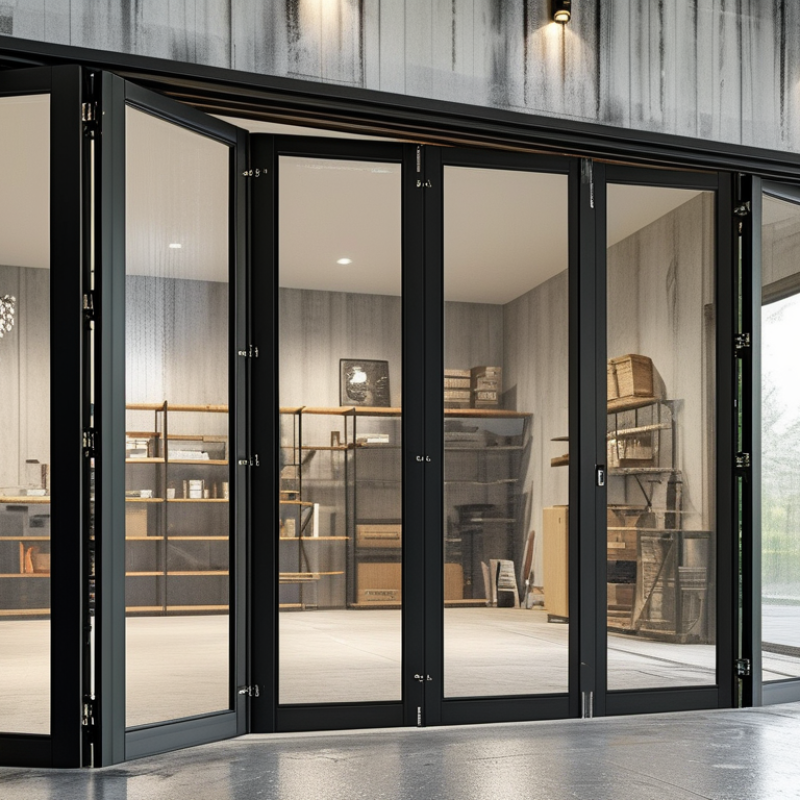
Bi-fold doors use hinged leaves that fold toward the sides. They open faster than standard sliding systems and need less stacking space. Multi-fold doors divide the opening into several linked panels. This arrangement can create a broad clear passage while reducing individual panel weight. However, hinges and connecting hardware require regular inspection. Uneven floors can also make folding movement rough. Measure twice.

Telescopic systems use overlapping sliding panels, often stacking within a compact zone. They are useful when the wall beside the opening cannot hold one full door width. Properly balanced rollers are essential, especially with tall steel or insulated panels. In my site reviews, buyers sometimes focus on maximum size and ignore wind exposure. That decision can increase wear. I once underestimated the effect of poor drainage on a lower guide, and the resulting corrosion appeared sooner than expected. Choose corrosion-resistant materials, accessible maintenance points, guarded edges, and clearly rated hardware. Safety sensors and controlled closing speeds should match the door’s actual weight, not an optimistic estimate.

Load Ratings: Compare 1,000–10,000 kg Sliding Panels and Track Systems

Top Heavy Duty Sliding and Folding Door Types for Buyers

Load ratings separate serious industrial doors from oversized residential systems. A 1,000 kg sliding panel may suit a compact warehouse opening, while a 10,000 kg panel requires engineered rollers, reinforced tracks, and controlled movement. The stated rating must cover the complete moving assembly, not only the door leaf. Ask for calculations covering panel weight, impact loads, wind pressure, and repeated cycles.

Track design often decides reliability. A 1,000–3,000 kg system may use multiple steel rollers on a protected floor track. Systems above 5,000 kg usually need wider rail sections, more bearing points, and tighter foundation tolerances. At 10,000 kg, even small alignment errors can create visible binding.

The 2024 World Steel Association “World Steel in Figures” report recorded 1.89 billion tonnes of crude steel production in 2023, showing the scale of steel manufacturing, but not proving any door’s capacity. That distinction matters.

European standard EN 13241 requires declared performance for industrial doors, while EN 12453 addresses safe use and operating forces. Neither standard replaces a project-specific load calculation. In field inspections, debris under a rail can feel like a structural failure. It may only be poor maintenance. Still, buyers should request tested load data, roller-life assumptions, anchor details, and deflection limits. Ratings can look precise. Real sites are less tidy.

Folding Door Hardware: 2–12 Leaves and 100,000-Cycle Testing

Heavy-duty folding doors rely on hardware that controls every movement. For two to four leaves, compact hinges and smooth rollers often provide efficient operation. Six to twelve leaves need stronger load distribution and careful track alignment. More leaves are not automatically better.

A 100,000-cycle test can reveal wear in rollers, hinges, guides, and locking points. It simulates repeated opening and closing under controlled conditions. However, this test is not a guarantee for every building. Dust, uneven floors, wind pressure, and poor installation can change results. Real projects remain less predictable.

In practical installations, I check whether the track stays level after the door carries its full weight. I also watch for scraping sounds and uneven gaps between leaves. These small details often expose alignment problems early. Hardware should match the door’s weight, leaf width, traffic frequency, and opening direction. Stainless or corrosion-resistant components may suit humid locations. Indoor dry spaces may need different finishes.

A twelve-leaf system requires disciplined installation. One misaligned panel can affect the entire folding sequence. Maintenance should include cleaning the track, checking fasteners, and inspecting rollers for flat spots. The weak point is sometimes simple: an overlooked floor guide. Testing data matters, but field conditions matter too.

Safety Standards: EN 13241, EN 12453, and Industrial Impact Protection

Top Heavy Duty Sliding and Folding Door Types for Buyers

Heavy duty sliding and folding doors must be selected beyond load capacity and opening speed. EN 13241 addresses the performance of industrial, commercial, and garage doors. It covers areas such as wind resistance, durability, and safe operation. Buyers should request test evidence and installation records, not only a product brochure.

EN 12453 focuses on the safe use of powered doors and gates. It requires attention to crushing, shearing, and impact risks during movement. A sliding door may need force limitation, safety edges, photocells, and controlled stopping. Folding doors require similar protection at hinges, panels, and closing zones. Industrial impact protection is also important. Breakaway sections, reinforced guides, and replaceable bottom edges can reduce damage after vehicle contact. Still, protection is never perfect.

Tips: Match the door to traffic speed, impact risk, and maintenance access. Ask who will test the safety devices after installation. Inspectors often find sensors misaligned by only a few millimetres. That small error matters. Keep clear records of inspections, repairs, and operator training. Standards help, but they do not replace a site-specific risk assessment. A door can pass a test and still perform poorly when the floor is uneven, lighting is weak, or operators rush. Buyers should allow space for these realities.

Top Heavy Duty Sliding and Folding Door Types for Buyers - Safety Standards: EN 13241, EN 12453, and Industrial Impact Protection

Door Type Typical Configuration Best-Fit Applications Heavy-Duty Characteristics Industrial Impact Protection Safety and Control Measures Relevant European Standards Buyer Verification Points
Bottom-Rolling Sliding Door One or more horizontal leaves supported by floor-mounted rollers and guided at the top. Warehouses, workshops, agricultural buildings, hangars, and large industrial openings. Suitable for very wide and tall openings; can accommodate substantial steel or insulated panels; floor tracks carry the main load. High structural robustness Vehicle-contact risk at track level Replaceable guides and rollers End stops, anti-derailment devices, finger protection at accessible gaps, locking arrangements, and guarded floor tracks where required. EN 13241 for product performance; EN 12453 where power operation is used. Confirm floor load capacity, track drainage, anti-derailment design, stopping distances, and force-limitation test results for powered versions.
Top-Hung Sliding Door Door leaves suspended from an overhead track, with floor guides used for lateral stability. Production halls, logistics buildings, clean industrial areas, and openings where a clear floor track is preferred. Provides a relatively unobstructed floor; requires a suitably engineered lintel or supporting steelwork for the suspended load. Reduced floor obstruction Overhead impact exposure Robust guide design needed Secondary suspension or anti-drop provisions, end stops, guarded rollers, safe access to the travel zone, and presence detection for automatic operation. EN 13241; powered movement and protective functions should be assessed under EN 12453. Check supporting structure, suspension redundancy, maximum leaf mass, wind exposure, guide tolerances, and emergency-release arrangements.
Telescopic Sliding Door Two or more leaves slide in the same direction, typically using linked carriages or synchronized drives. Sites with limited side-room, vehicle bays, process rooms, and large openings requiring compact stacking. Maximizes usable opening width within restricted side space; more moving components require careful alignment and maintenance. Moderate to high resistance Multiple pinch zones Vehicle protection recommended Guarded synchronization components, sensitive edges, photocells or light curtains, controlled opening speed, and safe separation from traffic routes. EN 13241; powered installations must address protective measures in EN 12453. Review stacking dimensions, leaf overlap, pinch-point protection, drive synchronization, maintenance access, and traffic-control integration.
Bi-Parting Sliding Door Two leaves move away from the center to create a symmetrical opening. Distribution centers, fire or acoustic separation zones where applicable, loading areas, and large industrial entrances. Balances loads and opening movement; can provide a broad clear passage while reducing travel distance per leaf. Good opening visibility Central closing hazard Impact posts recommended Central leading-edge protection, obstacle detection, controlled closing force, mechanical stops, warning signals, and emergency operation where required. EN 13241; safety of power-operated movement under EN 12453. Verify center meeting tolerances, closing-force measurements, obstacle detection, wind resistance, and protection from forklifts or trucks.
Folding Sliding Door Interconnected leaves fold into compact groups while traveling along a top or bottom guide. Aircraft and vehicle facilities, industrial workshops, maintenance depots, and buildings with limited parking clearance. Combines a large clear opening with relatively small parking depth; hinges, carriers, and guides need periodic inspection. Compact parking Hinge pinch hazards Impact-resistant hardware advised Finger-safe hinge arrangements, guarded folding zones, limit switches, safety edges, photocells, and controlled operating speed. EN 13241; powered folding action should meet applicable protective principles of EN 12453. Check hinge durability, carrier load rating, folding clearance, emergency opening, wind exposure, and access-control interfaces.
Accordion or Multi-Panel Folding Door Several narrow leaves fold and stack to one or both sides of the opening. Large equipment bays, industrial partitions, storage facilities, and areas requiring frequent full-width access. Can cover very large openings with limited parking space; leaf weight and repeated folding cycles determine hardware requirements. Moderate impact tolerance Many moving joints Traffic separation required Protective guards around hinges and carriers, safe edge monitoring, warning devices, low-energy movement where appropriate, and defined pedestrian routes. EN 13241; automatic operation requires risk reduction consistent with EN 12453. Assess cycle rating, leaf alignment, hinge replacement access, stacking footprint, pedestrian safety, and compatibility with high-wind conditions.
Industrial Sliding Impact Door Sliding door system with reinforced leaves, flexible or replaceable impact sections, and heavy-duty guides. Forklift routes, cold stores, loading docks, food-processing areas, and high-frequency logistics openings. Designed for repeated operation and recovery from accidental contact; construction varies widely, so performance evidence is essential. Designed for recurring impacts Replaceable impact components Traffic-rated options Traffic lights, radar or loop detection, protective bollards, speed control, visible warning signals, and separation of pedestrians from vehicles. EN 13241 applies to the door product; EN 12453 applies to safety in use when power-operated. These standards do not by themselves define a universal impact-resistance class. Request documented impact-energy or collision testing, recovery performance, replacement procedure, cycle rating, and site-specific traffic risk assessment.
Insulated Heavy-Duty Sliding Door Sliding leaves constructed with insulated panels, seals, thermal breaks, and mechanical or powered movement. Temperature-controlled warehouses, industrial production areas, energy-conscious buildings, and external service openings. Improves thermal separation and weather resistance; heavier leaves increase demands on tracks, rollers, hinges, and drives. Weather-resistant design Impact protection varies Protect seals from vehicles Sealed safety edges, photocells, controlled speed, protected bottom seals, emergency release, and protection against crushing or shearing. EN 13241 covers relevant door performance characteristics; powered safety functions are considered under EN 12453. Compare thermal transmittance, air and water resistance, wind resistance, sealing durability, impact-repair costs, and operating temperature range.
Fire- or Smoke-Control Sliding Door Sliding or horizontally moving door assembly designed as part of a fire or smoke compartmentation system. Industrial plants, warehouses, infrastructure buildings, and compartment boundaries where fire strategy requires a closing barrier. Uses specialized construction and tested hardware; fire performance depends on the complete tested assembly and installation conditions. Not a substitute for impact doors Protect from vehicle collision Automatic closing may be required Fail-safe release logic, obstruction monitoring, clearly defined manual operation, protected closing path, and coordination with fire-alarm systems. EN 13241 may apply to the product scope; fire resistance and smoke-control classification require the applicable fire-test and classification standards. Powered safety is addressed under EN 12453. Verify the complete fire classification, approved installation details, closing reliability, hold-open release, inspection schedule, and impact protection around the opening.
Buyer note: EN 13241 is a product standard covering performance characteristics for industrial, commercial, garage doors and gates. EN 12453 addresses safety in use for power-operated doors, gates, and barriers. Neither standard alone establishes one universal “industrial impact protection” rating; impact resistance should be confirmed through documented testing, project specifications, traffic-risk assessment, and the complete installed system.

Buyer Matrix: U-Values Below 1.4 W/m²·K and Wind Class 5 Performance

Top Heavy Duty Sliding and Folding Door Types for Buyers

Buyer Matrix: U-Values Below 1.4 W/m²·K and Wind Class 5 Performance

Heavy duty sliding doors suit wide openings, frequent use, and large glass panels. Lift-and-slide systems usually offer smoother movement under heavy loads. Folding doors create a larger clear opening but require more hinges, seals, and alignment checks. For both types, buyers should request a tested whole-door U-value below 1.4 W/m²·K. Glass-only figures can look impressive yet hide weaker frames or thresholds.

Look for thermally broken frames, low-emissivity double or triple glazing, continuous gaskets, and insulated sills. A well-designed drainage path matters during wind-driven rain. In site inspections, poorly adjusted rollers often create small gaps that reduce comfort and increase noise. It is an easy detail to overlook. Very easy.

Wind Class 5 performance indicates strong resistance in the declared test system, but the result depends on size, panel layout, fixing method, and test standard. Ask for test reports covering the actual configuration, not only a smaller sample. Corner openings and exposed coastal elevations deserve extra attention. Large folding panels may need more frequent hardware adjustment than sliding panels. I have found that maintenance access is often ignored during selection. That oversight can become expensive. Compare air leakage, water resistance, operating force, frame depth, threshold height, and replacement-part availability beside U-value and wind class.

Top Heavy-Duty Sliding and Folding Door Types

Buyer matrix: whole-door U-values below 1.4 W/m²·K and Wind Class 5 performance

The chart compares representative high-performance specification points for heavy-duty door configurations. Lower U-values indicate better thermal insulation. Wind Class 5 corresponds to a reference wind-pressure resistance of 2,000 Pa under EN 12210 classification. Final performance depends on size, glazing, hardware, installation, and certified test results.