
Choosing where to buy the best Trichlor Pool Chemical in China takes more than comparing prices. Buyers should examine product specifications, batch consistency, packaging, and the supplier’s ability to provide clear technical documentation. Small details matter. A damp or damaged bucket, for example, can raise handling concerns before the product even reaches a pool.
Dr. Ernest R. Blatchley III, a researcher in water treatment and swimming-pool disinfection, offers a useful principle. The following is a paraphrase, not a verified direct quotation: “Evaluate disinfectants by their chemistry and measured performance, not by the label alone.” That perspective can help buyers assess suppliers without relying on marketing claims. Ask for current test reports, stated available-chlorine content, production-batch records, and guidance on storage and use. Compare those details across qualified manufacturers and exporters in China.
A low quotation may not reflect the full cost. Freight, protective packaging, order size, and after-sales technical support can change the comparison. Look for consistent answers and documents that match the product being offered. Check that labels and specifications are easy to understand. Then verify the details independently where practical. No supplier should be judged by a polished brochure alone. This takes time. Still, careful checks can reduce avoidable surprises and help identify a dependable Trichlor Pool Chemical source for the intended application.
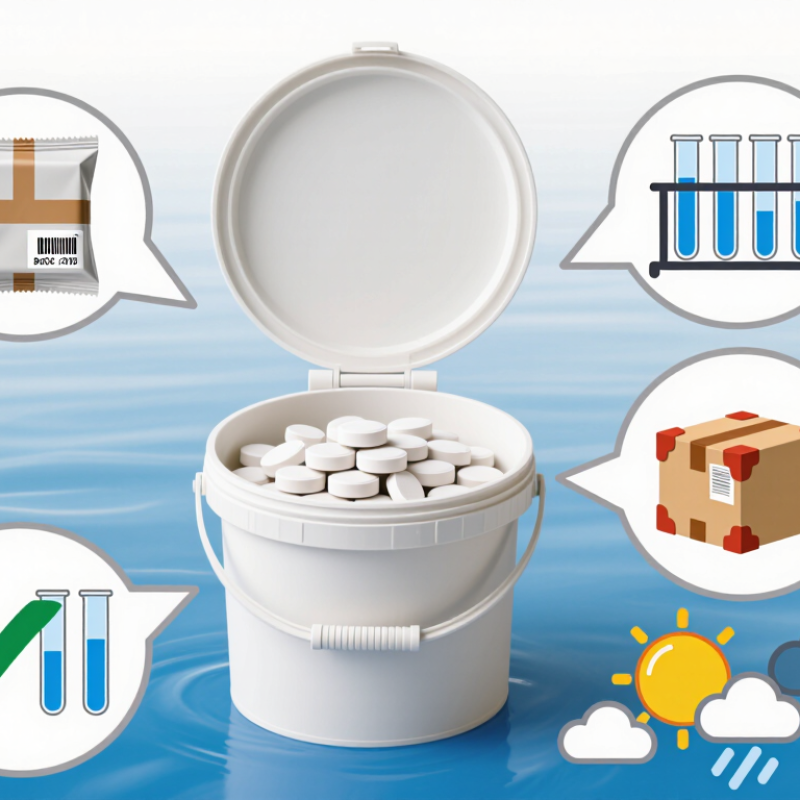
Trichlor, or trichloroisocyanuric acid, is a stabilized chlorine compound used to sanitize pool water. It releases chlorine gradually and also adds cyanuric acid, which helps limit sunlight-related chlorine loss. That stabilizer can build up over time, so regular water testing matters. Forms matter.
Tablets are the familiar option. They dissolve slowly in a compatible feeder or floater, making them useful for routine maintenance. Sticks are similar but may differ in size and dissolution rate. Granules dissolve more quickly, though they require careful application according to the product label. Never mix trichlor with other pool chemicals. Even dry materials can react dangerously.
When comparing suppliers in China, check the chemical name, available-chlorine specification, batch details, packaging condition, and safety data sheet. Ask how moisture is controlled during storage and shipping; damp or damaged packaging is a warning sign. A low price alone tells little. It is easy to assume all tablets behave alike, but water temperature, circulation, and feeder design can change how fast they dissolve. Match the form to your pool system, then verify water chemistry rather than relying on appearance.
Where to Buy the Best Trichlor Pool Chemical in China?
Where Trichlor Pool Chemicals Are Sold in China
In China, trichlor pool chemicals are commonly sold through water-treatment distributors, pool-equipment wholesalers, and chemical suppliers serving commercial facilities. Buyers can also find listings on domestic B2B marketplaces, but an online listing alone does not confirm product quality or local stock. Ask whether the seller supplies trichloroisocyanuric acid (TCCA) for swimming-pool use, and request a current product specification and certificate of analysis. Hotels, aquatic centers, and pool-maintenance contractors may also refer buyers to established regional suppliers. Availability can vary between coastal cities and inland areas.
Grand View Research’s Pool Chemicals Market Size, Share & Trends Analysis Report estimated the global pool chemicals market at about US$1.4 billion in 2023. This is global data, not a China-only sales figure, but it points to a substantial market supported by ongoing pool maintenance. When comparing Chinese sellers, check the available chlorine content, tablet or granule form, packaging condition, and delivery arrangements. Confirm that documents match the goods received. A low price is not enough. The supply map is not perfect; local inventory can change quickly.
Tips: Ask for a recent batch report, sealed-packaging photos, and a written quotation showing delivery costs. Confirm the seller’s experience with pool-water treatment, not just general chemical trading. Then compare two or three suppliers before ordering.
Where to Buy the Best Trichlor Pool Chemical in China?
How to Assess Chinese Manufacturers and Suppliers
Grand View Research’s 2024 swimming-pool chemicals report estimated the global market at about US$1.2 billion in 2023. That scale makes supplier checks worthwhile. Ask each Chinese manufacturer for a current business registration, factory address, product specification, and lot-specific certificate of analysis (COA). For trichlor, compare available-chlorine results against the agreed specification; around 90% is a common commercial grade, but confirm the exact product requirements. A polished brochure is not proof. Request an independent laboratory test on a sealed sample, and check whether the report identifies the same batch number shown on the package.
Assess production consistency, not just price. Ask how the supplier controls moisture, granule size, and packaging integrity during storage and shipping. Request recent test records and a safety data sheet, then verify that documents match the product being quoted. ISO 9001 certification can indicate a quality-management system, but it does not guarantee every batch meets specification. If possible, arrange a factory audit or use a qualified third-party inspection service. One weakness: a single passing sample cannot establish long-term consistency.
Tips: Compare at least three recent COAs. Check batch numbers, dates, and test methods. Start with a small trial order, inspect the drum seals on arrival, and retain a sealed sample for comparison.
| Assessment dimension | What to verify | Practical evidence or benchmark | Buyer action |
|---|---|---|---|
| Product identity | Confirm that the product is trichloroisocyanuric acid (TCCA), rather than another chlorine donor. | Check the product specification, certificate of analysis (COA), safety data sheet (SDS), and chemical identity. TCCA has CAS No. 87-90-1. | Make chemical identity and grade explicit in the purchase contract. |
| Available chlorine | Compare the stated available-chlorine assay and the test method used. | Commercial TCCA is commonly sold at about 90% available chlorine; this is a typical grade reference, not a guarantee for every product. Require a lot-specific COA and agreed tolerance. | Set a minimum assay and an independent retesting procedure before ordering. |
| Product form and use | Match tablets, granules, or powder to the intended feeder, application method, and pool-maintenance plan. | Ask for tablet dimensions and weight, or particle-size information where relevant. Dissolution depends on product form and operating conditions; request test data for the specified grade. | Approve a representative sample and define the required physical properties in writing. |
| Batch consistency | Check whether each shipment can be traced to a production lot and whether the supplier retains quality records. | Request batch numbers, dated COAs, sampling details, and written procedures for handling nonconforming product. | Make lot traceability and inspection rights contractual requirements. |
| Manufacturer or trading supplier | Determine whether the seller makes the product or sources it from another facility. | Request the Chinese business registration details, business scope, production-site address, and a live or third-party factory audit. Confirm who is responsible for quality and export documentation. | Verify the legal contracting party and production site independently before paying a deposit. |
| Testing and quality controls | Assess the supplier’s testing capability and the reliability of its reported results. | Ask for test methods and equipment records. For high-value or first-time orders, use a laboratory accredited to ISO/IEC 17025 for the relevant test where available. | Agree in advance how samples are selected, sealed, tested, and resolved if results differ. |
| Safety and handling documents | Ensure the SDS matches the exact product and packaging being shipped. | TCCA is an oxidizing chemical. Review the SDS for hazards, incompatibilities, storage, spill response, and first aid; confirm current transport classification with the supplier and carrier. | Do not accept incomplete or inconsistent safety and transport documents. |
| Packaging and storage | Check package integrity, moisture protection, labeling, and suitability for the planned route and storage period. | Confirm packaging material, net weight, lot labeling, seals, palletization, and storage instructions. Keep TCCA dry and segregated from incompatible materials, including acids and ammonia-containing products. | Specify packaging and labeling requirements, and inspect shipment photos or samples before dispatch. |
| Export and destination compliance | Confirm the supplier can support the destination market’s import, labeling, and chemical requirements. | Request the commercial invoice, packing list, origin documentation if needed, SDS, COA, and any destination-specific documents. Requirements vary by country and shipment route. | Check requirements with the importer, customs broker, and carrier before production or shipment. |
| Price and delivery terms | Compare total landed cost rather than the quoted product price alone. | Compare equivalent grade, packaging, order quantity, Incoterm, freight, insurance, payment terms, and lead time. Verify the named place and version of the Incoterm in the quotation. | Use the same specification and delivery basis when requesting competing quotations. |
| Sample and order safeguards | Evaluate product quality and supplier responsiveness before committing to a large shipment. | Request a pre-shipment sample, confirm the sample’s lot and test records, and agree on inspection timing, rejection criteria, and remedies for off-spec goods. | Start with a controlled trial order when practical; document acceptance criteria in the contract. |
Note: The assay figure is a typical commercial reference only. Confirm the applicable product specification, test method, safety requirements, and import rules for each purchase and destination.
When buying trichlor pool chemical in China, check the paperwork before comparing prices. The label should identify trichloroisocyanuric acid, available chlorine, net weight, batch number, and production date. Ask for a lot-specific certificate of analysis, not just a generic product sheet. Compare its results with the stated specification, and request a current safety data sheet. Small details matter.
Confirm the product is intended for pool-water treatment and that its documents meet applicable Chinese requirements. Requirements can change, so verify them with a relevant authority or qualified compliance professional. Check that the supplier can trace the shipment to its manufacturer and provide intact, clearly labeled packaging. A damp or damaged container deserves questions. Ask how the chemical should be stored and transported, then follow the label and safety data sheet; keep it dry and away from incompatible materials. I would not treat a low price as proof of poor quality, but incomplete records make comparison difficult. Sometimes the documents look tidy. Verify the batch anyway.
Buying trichlor in China is less about the lowest quote and more about delivered cost per usable kilogram. Ask suppliers to quote the same grade, available-chlorine specification, order volume, and destination. Request a recent certificate of analysis and batch number; otherwise, a low price is hard to compare. Keep it simple. Compare one-kilogram pails, five-kilogram buckets, and 25-kilogram drums, if available. Smaller packs are easier to handle at pool sites, while larger drums may reduce packaging costs per kilogram. But they can require more storage space and heavier unloading equipment. Liners, seals, pallet dimensions, and packaging weight can also change freight charges.
The World Bank’s 2023 Logistics Performance Index gave China a score of 3.7 out of 5 and ranked it 19th among 139 economies. The index considers customs, infrastructure, shipment arrangements, and delivery timeliness. Treat this as useful context, not a promise about one shipment. Ask for the dispatch lead time, warehouse or port location, door-to-door price, and any destination fees. Compare sea freight with domestic trucking where relevant. Confirm transport classification and moisture-resistant packaging before ordering. I would also check tracking and damage procedures, not only estimated transit days. That detail is easy to miss. A cheaper large drum may be poor value if your site cannot unload it safely.
The chart shows illustrative planning ranges in CNY/kg, not verified live quotations. Pack sizes and delivery times vary by seller, destination, order volume, and transport requirements. Request a dated quote, product specification, safety data sheet, and confirmed delivery terms before purchasing.